The SSB Interview 2027 is one of the most important stages for defence aspirants who want to become officers in the Indian Armed Forces. Clearing the written examination is an important achievement, but the journey does not end there. Candidates must demonstrate their overall personality, leadership potential, communication skills, teamwork, decision-making ability and suitability for military life during the SSB selection process.
For many aspirants, the SSB process can initially seem challenging because it includes multiple assessments conducted over several days. Understanding the complete process in advance can help candidates prepare with greater confidence and avoid unnecessary confusion.
In this comprehensive guide, we explain the SSB Interview 2027 process, including Screening, Psychology Tests, GTO Tasks, Personal Interview and Conference. We also cover practical preparation tips and explain how LWS SSB Interview helps aspirants prepare for the complete selection process.
What Is the SSB Interview?
The Services Selection Board (SSB) assesses candidates for their suitability for an officer career in the Armed Forces. Unlike a conventional academic examination, SSB focuses on the candidate’s overall personality and behaviour.
The assessment is conducted through a combination of psychological tests, group activities, interviews and observation. Candidates are expected to demonstrate their natural abilities rather than simply memorising prepared answers.
- Psychological assessment.
- Group activities and leadership assessment.
- Personal Interview.
- Communication and reasoning ability.
- Teamwork and cooperation.
- Decision-making and problem-solving.
- Confidence and responsibility.
- Overall suitability for an officer role.
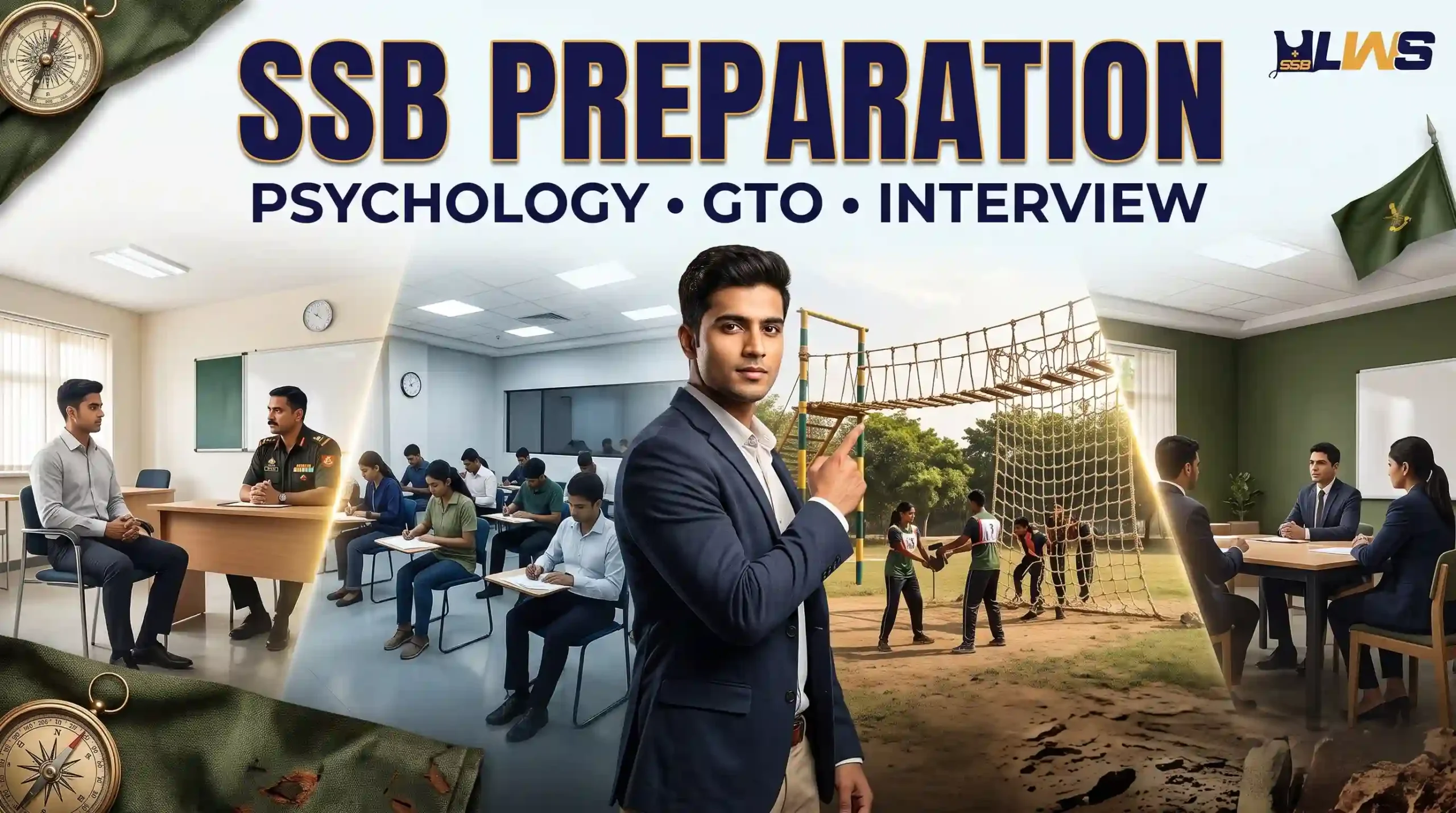
SSB Interview 2027: Complete 5-Day Process
The SSB process is commonly understood as a five-day assessment after the initial reporting and documentation formalities. Candidates should understand that the exact sequence and timings can vary according to the entry and selection centre.
The major stages generally include:
- Day 1: Screening Tests.
- Day 2: Psychology Tests.
- Day 3: GTO Tasks.
- Day 4: GTO Tasks and Personal Interview as scheduled.
- Day 5: Remaining assessments and Conference.
Rather than memorising the schedule, candidates should focus on understanding the purpose of each stage and developing the qualities required to perform naturally.
Day 1: Screening Test
The first day is extremely important because candidates must clear the initial screening stage to continue with the remaining SSB assessments.
The screening stage generally includes an intelligence test followed by a Picture Perception and Discussion Test (PPDT).
Intelligence Test
The intelligence test assesses basic reasoning and cognitive ability. Questions can involve verbal and non-verbal reasoning, numerical ability and logical thinking.
- Practise basic reasoning questions.
- Improve calculation speed.
- Practise verbal and non-verbal reasoning.
- Develop accuracy under time pressure.
- Take timed practice tests.
Picture Perception and Discussion Test (PPDT)
In PPDT, candidates are shown a picture and are generally required to interpret it, create a story and participate in a group discussion.
The objective is not to create an unrealistic or dramatic story. Candidates should focus on observing the picture carefully, identifying relevant details and presenting a practical and logical interpretation.
- Observe the picture carefully.
- Identify the main character or characters.
- Understand the situation logically.
- Create a realistic and constructive story.
- Present your ideas clearly.
- Listen to other candidates during discussion.
- Participate without aggressively dominating the group.
How to Perform Better in Screening
Many candidates make the mistake of speaking continuously during the PPDT discussion. Effective participation is more important than simply speaking more.
- Speak clearly and confidently.
- Listen carefully to other candidates.
- Do not shout or interrupt unnecessarily.
- Support your points with logical reasoning.
- Remain calm if the group disagrees with you.
- Contribute constructively to the discussion.
Day 2: Psychology Tests
Candidates who clear the screening stage proceed to the detailed assessment. Psychology tests are designed to understand different aspects of a candidate’s personality, thinking process and behavioural tendencies.
The major psychological assessments generally include:
- Thematic Apperception Test (TAT).
- Word Association Test (WAT).
- Situation Reaction Test (SRT).
- Self Description Test (SD).
Thematic Apperception Test (TAT)
In TAT, candidates are shown a series of pictures and are asked to write stories based on them. The focus should be on responding naturally and logically rather than trying to write a stereotypical “perfect officer” story.
- Observe the situation carefully.
- Build a practical and meaningful story.
- Focus on action and problem-solving.
- Keep the response realistic.
- Manage your time effectively.
Word Association Test (WAT)
WAT involves responding to a series of words within a limited time. The purpose is to understand how a candidate naturally responds to different ideas and situations.
Instead of memorising hundreds of prepared sentences, develop a habit of thinking positively, practically and quickly.
Situation Reaction Test (SRT)
SRT presents candidates with different situations and asks them to provide responses. The test is intended to understand practical thinking, decision-making and response to everyday challenges.
- Read situations carefully.
- Think practically.
- Prioritise safety and responsibility.
- Take appropriate action instead of avoiding the situation.
- Keep responses realistic.
Self Description Test
The Self Description Test gives candidates an opportunity to describe themselves and how they are perceived by people around them.
- Be honest.
- Understand your strengths.
- Recognise areas where you need improvement.
- Avoid presenting an artificial personality.
- Maintain consistency between your responses and real-life behaviour.
Day 3 & Day 4: GTO Tasks
The Group Testing Officer (GTO) assesses candidates through a series of individual and group activities. These tasks are designed to observe qualities such as teamwork, cooperation, communication, initiative, leadership and practical problem-solving.
Common GTO activities can include:
- Group Discussion.
- Group Planning Exercise.
- Progressive Group Task (PGT).
- Group Obstacle Race / Snake Race.
- Half Group Task (HGT).
- Lecturette.
- Individual Obstacles.
- Command Task.
- Final Group Task (FGT).
Group Discussion
Group Discussion tests your ability to communicate ideas, listen to others and contribute constructively to a group.
- Understand the topic before speaking.
- Speak clearly and confidently.
- Use relevant examples.
- Listen to other candidates.
- Do not unnecessarily interrupt.
- Encourage constructive discussion.
- Focus on quality rather than quantity of speech.
Group Planning Exercise
In the Group Planning Exercise, candidates are generally presented with a situation involving multiple problems and are expected to develop a practical plan.
The task tests observation, prioritisation, planning, teamwork and decision-making.
- Identify all important problems.
- Prioritise them logically.
- Consider available resources.
- Develop a practical solution.
- Communicate your plan clearly.
Progressive Group Task (PGT)
PGT involves solving group obstacles using the resources and rules provided by the GTO. The emphasis is on teamwork and practical problem-solving.
- Understand the rules before starting.
- Contribute useful ideas.
- Help team members.
- Remain calm when a solution does not work.
- Take initiative without trying to dominate.
Half Group Task (HGT)
HGT is similar in nature to group obstacle activities but is conducted with a smaller group. The reduced group size can provide more opportunities for individual participation.
Focus on cooperation, communication and practical solutions rather than trying to prove that you are the strongest person in the group.
Group Obstacle Race
The Group Obstacle Race involves teamwork, coordination and physical effort. Candidates should participate enthusiastically while maintaining awareness of the team.
- Stay energetic.
- Support your team members.
- Follow instructions.
- Maintain coordination.
- Do not focus only on your individual performance.
Lecturette
Lecturette assesses communication, confidence, awareness and the ability to organise thoughts quickly.
- Choose a topic you can explain logically.
- Organise your points before speaking.
- Maintain a confident posture.
- Speak clearly.
- Use simple and effective language.
- Maintain appropriate eye contact.
Individual Obstacles
Individual Obstacles test physical confidence, determination and the ability to perform independently.
- Develop basic physical fitness before reporting.
- Practise running and bodyweight exercises.
- Improve agility and stamina.
- Follow safety instructions.
- Attempt obstacles with confidence.
Command Task
Command Task provides an opportunity for the candidate to take responsibility and guide others while solving an obstacle-based problem.
- Understand the problem first.
- Give clear instructions.
- Listen to your subordinate members.
- Use available resources effectively.
- Remain calm when your first plan does not work.
- Take responsibility for your decisions.
Final Group Task
The Final Group Task provides another opportunity to demonstrate teamwork and practical problem-solving. Candidates should finish the process with the same level of enthusiasm and cooperation with which they started.
Personal Interview
The Personal Interview is an important part of the SSB assessment. The Interviewing Officer may ask questions about your education, family, hobbies, friends, interests, achievements, responsibilities, current affairs and reasons for joining the Armed Forces.
The objective is not to conduct a conventional job interview where candidates need to memorise impressive answers. The interview is intended to understand the candidate as an individual.
Common Areas Asked in the SSB Interview
- Educational background.
- School or college life.
- Academic performance.
- Family background.
- Friends and social relationships.
- Hobbies and interests.
- Sports and extracurricular activities.
- Achievements and responsibilities.
- Strengths and areas for improvement.
- Current affairs.
- Reasons for joining the Armed Forces.
- Knowledge about the chosen service.
How to Prepare for the Personal Interview
The best approach is to know yourself well. Candidates should be able to discuss their experiences honestly and explain their decisions logically.
- Know your academic record.
- Understand your hobbies.
- Be aware of your strengths and weaknesses.
- Prepare basic information about your hometown and surroundings.
- Follow current affairs.
- Know why you want to join the Armed Forces.
- Answer honestly.
- Do not memorise artificial responses.
Day 5: Conference
The Conference is the final stage of the SSB assessment. The assessors discuss the candidate’s performance across different stages and arrive at a final recommendation based on the overall assessment.
The candidate may be asked a few questions during the Conference. Remain calm, polite and confident.
What Are Officer-Like Qualities?
SSB is not designed simply to test academic knowledge. Assessors look for qualities relevant to an officer’s responsibilities. These are commonly described as Officer-Like Qualities (OLQs).
- Effective intelligence.
- Reasoning ability.
- Organising ability.
- Power of expression.
- Social adaptability.
- Cooperation.
- Sense of responsibility.
- Initiative.
- Self-confidence.
- Speed of decision.
- Ability to influence the group.
- Liveliness.
- Determination.
- Courage.
- Stamina.
These qualities should not be treated as items to memorise. They can be developed through real-life habits, responsibilities, teamwork, sports, communication and disciplined decision-making.
How to Develop OLQs Before SSB Interview 2027
Personality development should start well before you receive your SSB call letter. Small daily habits can gradually improve your confidence and behaviour.
- Participate in sports and team activities.
- Take responsibility for household and academic tasks.
- Practise public speaking.
- Participate in group discussions.
- Read newspapers and discuss current issues.
- Develop decision-making skills.
- Help others when appropriate.
- Learn from failures instead of avoiding challenges.
- Maintain a disciplined routine.
- Develop healthy physical fitness habits.
Importance of Communication Skills in SSB
Communication plays an important role throughout the SSB process. However, effective communication does not mean speaking continuously or using complicated English.
A good communicator can express ideas clearly, listen to others and respond appropriately.
- Speak clearly.
- Organise your thoughts before speaking.
- Listen actively.
- Respect different opinions.
- Use simple and understandable language.
- Practise speaking on current affairs topics.
Current Affairs Preparation for SSB 2027
Current affairs can be useful during the Interview, Lecturette, Group Discussion and other interactions. Candidates should develop an understanding of important events instead of simply memorising headlines.
- National issues.
- International developments.
- Defence news.
- Military exercises.
- Important appointments.
- Science and technology.
- Sports.
- Government initiatives.
- Important geopolitical developments.
Physical Fitness for SSB Interview
Physical fitness can help candidates participate confidently in outdoor GTO activities and individual obstacles. You do not need to follow extreme training routines. Consistency is more important.
- Regular running or jogging.
- Basic strength exercises.
- Mobility and flexibility exercises.
- Outdoor sports.
- Gradual stamina development.
- A balanced diet and adequate recovery.
Candidates should prepare according to their own fitness level and follow safe training practices.
Common Mistakes Candidates Make During SSB
- Trying to act like a completely different person.
- Memorising artificial answers.
- Speaking aggressively during group discussions.
- Remaining completely silent in group activities.
- Ignoring other group members.
- Giving contradictory information during different assessments.
- Not knowing their own hobbies and experiences.
- Ignoring current affairs.
- Starting physical preparation at the last moment.
- Preparing only for the interview and ignoring GTO and psychology tests.
- Focusing too much on impressing assessors.
How LWS SSB Interview Helps You Prepare for SSB 2027
LWS SSB Interview focuses on comprehensive preparation rather than preparing candidates for only one part of the selection process. The objective is to help aspirants understand the SSB environment, practise different assessments and develop the confidence required to perform naturally.
- Structured SSB Interview preparation.
- Psychology test practice.
- PPDT and screening preparation.
- Realistic GTO practice sessions.
- Group Discussion practice.
- Lecturette preparation.
- Personal Interview mock sessions.
- Command Task and outdoor task practice.
- Communication and personality development.
- Officer-Like Qualities development.
- Performance feedback and mentorship.
- Current affairs guidance.
Why Choose LWS SSB Interview?
SSB preparation becomes more effective when candidates receive opportunities to practise, make mistakes and understand how they can improve. LWS SSB Interview provides an environment where aspirants can experience different components of the selection process and receive guidance from experienced defence mentors.
The focus is not on creating a fake personality. Instead, candidates are encouraged to understand their strengths, work on their weaknesses and develop practical communication, leadership, teamwork and decision-making skills.
SSB Interview 2027 Preparation Strategy
A practical SSB preparation strategy should combine written knowledge, personality development, physical fitness and regular practice.
- Step 1: Understand the complete SSB process.
- Step 2: Practise Screening and PPDT.
- Step 3: Develop psychological test-writing habits.
- Step 4: Participate in regular group activities.
- Step 5: Improve communication and public speaking.
- Step 6: Prepare for Personal Interview questions.
- Step 7: Follow current affairs.
- Step 8: Maintain physical fitness.
- Step 9: Participate in mock SSB assessments.
- Step 10: Analyse feedback and continuously improve.
Frequently Asked Questions About SSB Interview 2027
1. What is the SSB Interview 2027 process?
The SSB process generally involves Screening, Psychology Tests, GTO Tasks, Personal Interview and Conference. Candidates are assessed across multiple activities to determine their suitability for an officer role.
2. How many days is the SSB Interview?
The core SSB assessment is commonly conducted over five days after reporting and documentation formalities. The exact schedule can vary according to the entry and selection centre.
3. What happens on the first day of SSB?
The first day generally includes the Screening Test, which includes an intelligence test and Picture Perception and Discussion Test (PPDT). Candidates who clear the screening stage continue with the subsequent assessments.
4. Is SSB only about the Personal Interview?
No. The Personal Interview is only one component. Candidates are assessed through screening, psychology tests, GTO activities, interview and conference.
5. How can I prepare for GTO Tasks?
Develop teamwork, communication, physical fitness, practical problem-solving and leadership skills. Regular GTO practice under realistic conditions can also help you become more comfortable with outdoor tasks.
6. Should I memorise answers for the SSB Interview?
No. Memorised answers can appear unnatural and may create inconsistencies during different assessments. Focus on knowing yourself, improving communication and answering honestly.
7. When should I start SSB preparation?
It is better to start early. Communication, physical fitness, current affairs, teamwork and personality development take time to develop and should not be left until the final few days.
8. Can LWS SSB Interview help freshers?
Yes. LWS SSB Interview provides structured guidance for both freshers and experienced candidates through screening practice, psychology preparation, GTO activities, mock interviews, personality development and mentorship.
Final Thoughts on SSB Interview 2027
The SSB Interview 2027 is not an examination that can be cracked simply by memorising questions and answers. It is a comprehensive assessment of how you think, communicate, interact, respond to situations and work with others.
Start preparing early. Develop your communication skills, stay physically active, follow current affairs, participate in group activities and understand your own strengths and areas for improvement.
Most importantly, remain authentic. Do not try to create a fake officer-like personality for five days. Instead, work consistently on the qualities that can help you become a better individual and future leader.
LWS SSB Interview provides comprehensive preparation through Psychology, GTO, Mock Interviews, PPDT, personality development and experienced mentorship.
Start your SSB journey with LWS SSB Interview and prepare confidently for every stage of the SSB process in 2027.